Goldfields First: How Fortune Bay’s Partner-Funded Uranium Portfolio Adds Optionality Without Diluting the Core Thesis
Canada’s Nuclear Energy Strategy, released June 22, 2026, names expanding uranium production and nuclear fuel opportunities as one of four strategic pillars for the country’s energy future. Saskatchewan is the sole location of all active uranium mining in Canada, contributing $2.6 billion to the national economy in 2024, and Canada is the world’s second-largest uranium producer. The federal government’s commitment to growing that production base sets a meaningful policy context for investors assessing Athabasca Basin uranium exposure.
Fortune Bay holds three uranium properties in the Athabasca Basin: Murmac, Strike, and The Woods. Each operates under a partner-funded earn-in agreement in which a third-party partner funds the exploration program and Fortune Bay earns fees as operator. The result is Athabasca Basin uranium exposure for Fortune Bay shareholders, structured so that capital for Goldfields’ development program remains fully intact.
The Earn-In Model: Partner Capital, Fortune Bay Operatorship
The uranium portfolio, specifically Murmac, Strike, and The Woods, operates entirely under option agreements, with Fortune Bay retained as operator on each property. Optionholders fund the exploration programs; Fortune Bay earns non-dilutive income through option payments and operator fees. Fortune Bay’s treasury does not fund uranium exploration. The uranium properties generate income for Fortune Bay while requiring none of the capital allocated to Goldfields.
Retaining operatorship on each property is not incidental to the structure. It means the exploration programs at Murmac, Strike, and The Woods are directed by a management team with extensive Athabasca Basin exploration experience, including at the discovery level. Partner capital funds the work; Fortune Bay’s technical capability shapes how that capital is deployed.
Manhattan Uranium’s commencement of drilling at Murmac in June 2026 demonstrates the structure in practice. The current program encompasses 5,000 metres of drilling across 25 targets at Murmac and Strike. Manhattan is funding the program; Fortune Bay manages it and receives the associated fees. The exploration activity is funded by a third party, not by shareholders of Fortune Bay.
The Athabasca Basin as a Strategic Address
The Athabasca Basin has a specific significance beyond its production statistics. It has been the source of some of the highest-grade uranium discoveries in mining history, and properties within the basin carry a jurisdictional premium: Saskatchewan’s regulatory framework for uranium development is well established, and the province’s long track record as a producer has built an experienced workforce and supply chain that supports active exploration.
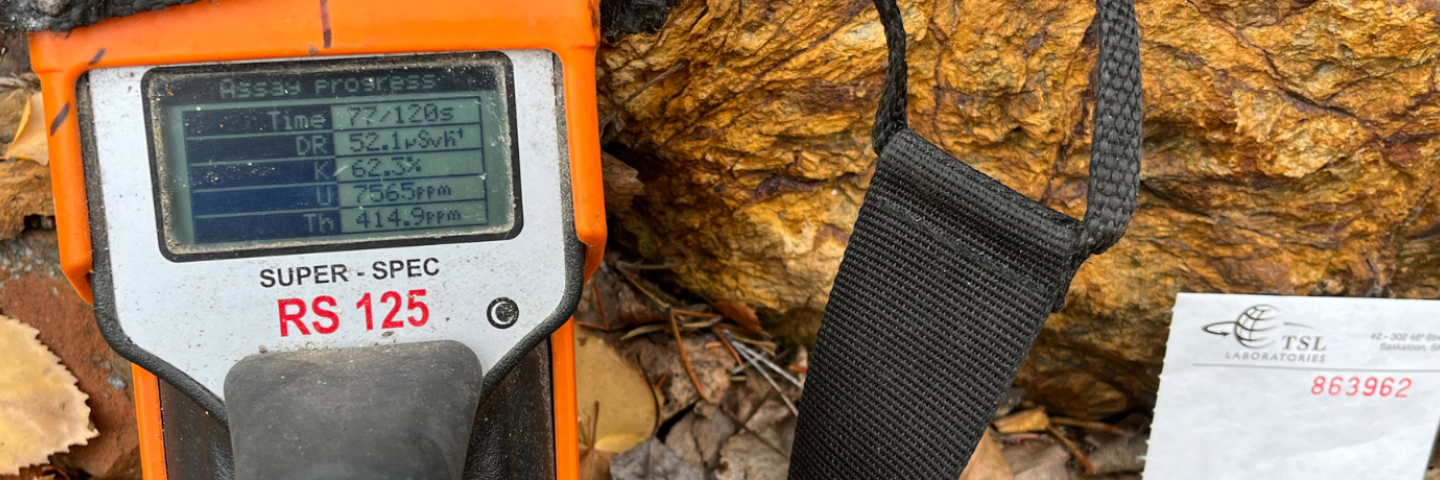
Murmac sits in the Uranium City district, a historically producing region with approximately 70 million pounds of historical uranium production. Those earlier mines targeted granite-hosted deposits; the high-grade uranium deposits typical of modern Athabasca Basin exploration occur in graphitic rock formations that were largely overlooked by earlier prospecting cycles. That distinction makes the current targets at Murmac and Strike genuinely prospective: geological settings with the right characteristics for high-grade discovery that were not systematically tested during the original development era in the region.
For Fortune Bay shareholders, the uranium properties are not a uranium company investment. They are exposure to exploration activity in a strategically significant address, funded by a partner, and managed by a team with direct basin expertise. CEO Dale Verran spent a significant part of his career at Denison Mines, managing a $20M annual exploration budget and contributing to multiple basin discoveries. Fortune Bay’s operatorship of these properties reflects a deliberate alignment of technical capability with partner capital.
The distinction matters: Fortune Bay shareholders gain optionality on Athabasca Basin exploration results without Fortune Bay committing development capital to make those results happen.
Goldfields Stays the Anchor
Goldfields is the primary thesis. It is an advanced gold development project in Saskatchewan with a high-confidence resource base, robust after-tax economics, and a clear pathway toward a Pre-Feasibility Study. The partner-funded uranium portfolio exists alongside that thesis, not in competition with it: the structure is designed precisely so that Goldfields development capital remains allocated to Goldfields.
PFS-level studies are advancing across metallurgy, geotechnical, waste rock characterization, and environmental work, as covered in detail in “How PFS-Level Studies Are De-risking the Goldfields Project”. Each workstream completion removes a discrete category of project risk and contributes to the re-rating case ahead of the formal Pre-Feasibility Study.
The partner-funded uranium portfolio is additive to that primary thesis. It does not compete for the capital that funds Goldfields’ technical programs. It does not draw on the management attention required to advance PFS workstreams. And it contributes non-dilutive income to the treasury. It is the right kind of portfolio addition: one that earns its presence without diluting the core story.
Discipline as a Portfolio Principle
Fortune Bay’s approach to non-Goldfields assets reflects a consistent capital discipline principle: no additional asset should require Fortune Bay to choose between that asset and the primary development thesis. The partner-funded earn-in structures on Murmac, Strike, and The Woods achieve exactly that. Manhattan drills Murmac because the earn-in requires it; Fortune Bay earns fees because it manages the program. If the drilling returns significant results, Fortune Bay shareholders benefit from the retained interest. If results are modest, the Goldfields development trajectory is unaffected.
For investors evaluating Fortune Bay, the relevant question is not whether the uranium assets represent a distraction. It is whether the portfolio structure supports or undermines the Goldfields development thesis. The earn-in model answers that directly: every non-Goldfields asset in the portfolio is structured to advance on partner capital, not Fortune Bay capital.
For monthly updates on Goldfields’ advancement and Fortune Bay’s portfolio of assets, subscribe to Inside Fortune Bay, the monthly investor newsletter, or follow @fortunebaycorp for between-newsletter updates.
Frequently Asked Questions
Does Fortune Bay’s uranium portfolio compete with Goldfields for capital?
No. All three uranium properties, Murmac, Strike, and The Woods, are held under option agreements in which Fortune Bay’s partners fund the exploration programs and Fortune Bay operates them for a management fee. Fortune Bay does not allocate development capital to uranium exploration. Option payments and operator fees are the financial return to Fortune Bay’s treasury from these properties. The structure is designed specifically so that Goldfields remains the sole destination for Fortune Bay’s development capital.
What is a partner-funded earn-in and why does it matter to a gold development company?
A partner-funded earn-in is a structure in which a third-party optionholder funds defined exploration work on a property in exchange for earning an equity interest over time, while the property owner retains operatorship and collects fees for managing the program. For Fortune Bay, this structure allows the company to hold meaningful uranium leverage in the Athabasca Basin without directing any portion of its treasury toward uranium exploration. Investors in Fortune Bay gain commodity and geographic optionality through the uranium portfolio without one asset class competing with the other for capital allocation.
Why does Manhattan Uranium drilling at Murmac matter to Fortune Bay shareholders?
Manhattan Uranium’s commencement of drilling at Murmac in June 2026 confirms that the earn-in structure is active and producing direct benefit to Fortune Bay shareholders. Manhattan is funding the program; Fortune Bay manages it and earns fees. If the drilling returns significant results, Fortune Bay’s retained interest in the property increases in value. If results are unremarkable, Goldfields’ development trajectory is unaffected. The program illustrates how portfolio optionality is structured to work: third-party capital, Fortune Bay expertise, no cost to Goldfields development momentum.
Why is Saskatchewan’s jurisdictional profile relevant to both the gold and uranium assets in Fortune Bay’s portfolio?
Saskatchewan ranks 2nd in Canada and 3rd globally for mining investment attractiveness in the Fraser Institute Annual Survey 2025, a ranking applicable to both the gold and uranium sectors. The province has supported large-scale uranium production through the Athabasca Basin for decades and has a well-established regulatory framework for precious metals development. Both Goldfields and the uranium portfolio benefit from a jurisdiction where policy risk and regulatory unpredictability are low and where existing infrastructure supports project economics.
Forward-Looking Statements
This blog post contains certain forward-looking statements relating to Fortune Bay Corp., the Goldfields Gold Project, and Fortune Bay’s uranium and other portfolio assets. Forward-looking statements include, but are not limited to, statements concerning portfolio structure, option agreement terms and outcomes, partner exploration programs, project economics, and development timelines. Forward-looking statements are based on management’s estimates, assumptions, and expectations as of the date of this post, and are subject to known and unknown risks and uncertainties that could cause actual results to differ materially from those expressed or implied by such statements. Readers are cautioned not to place undue reliance on forward-looking statements. Fortune Bay Corp. assumes no obligation to update forward-looking statements, except as required by applicable securities laws.
Follow the progress.
Drilling results, development updates, and investor insights delivered straight to your inbox.